1–3billion years
Natural diamonds
Formed deep within the earth and carried to the surface by ancient volcanic activity.
- Rare and finite
- Each one a piece of geological history
- Graded by laboratories such as GIA and IGI
Forzono Fine Jewelry
A little knowledge. A lifetime of brilliance.
Everything you need to choose with confidence, from the 4Cs to finding the perfect size, explained simply by our team.
 Interactive
Diamond Size GuideSee how each carat looks
 The Diamond 4CsLearn what makes diamonds special
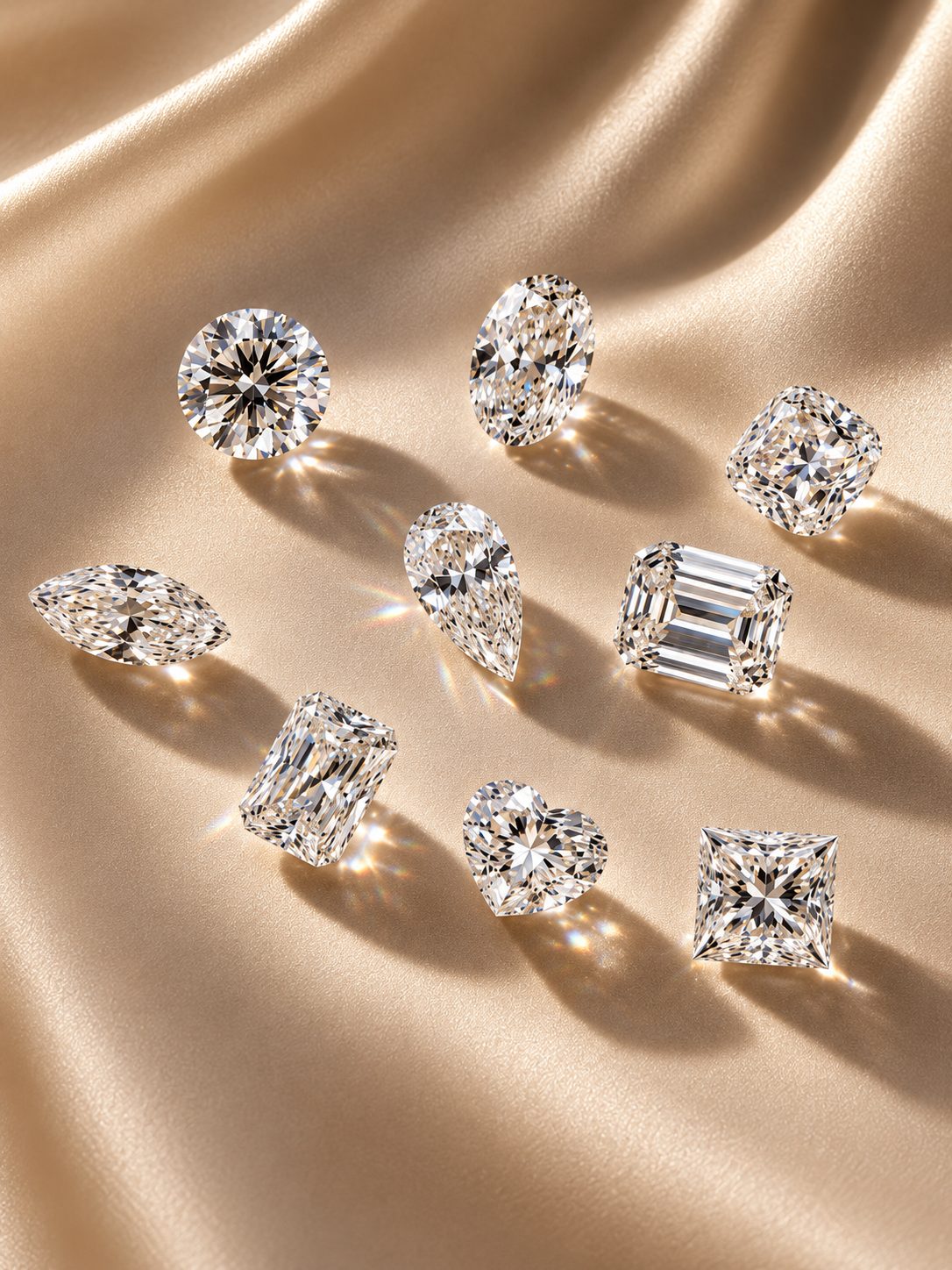 Diamond ShapesRound, oval, emerald and more
 Natural vs. Lab-GrownHow they form, and how they compare
 Precious MetalsGold, platinum and more
 Ring Settings & StylesExplore your perfect setting
 Earring GuideStuds, settings, backs and sizing
 Gemstone LibraryColor, meaning and durability
 Find Your Perfect Fit & Keep Your Jewelry BeautifulRing sizes, lengths and cleaning
Interactive guide
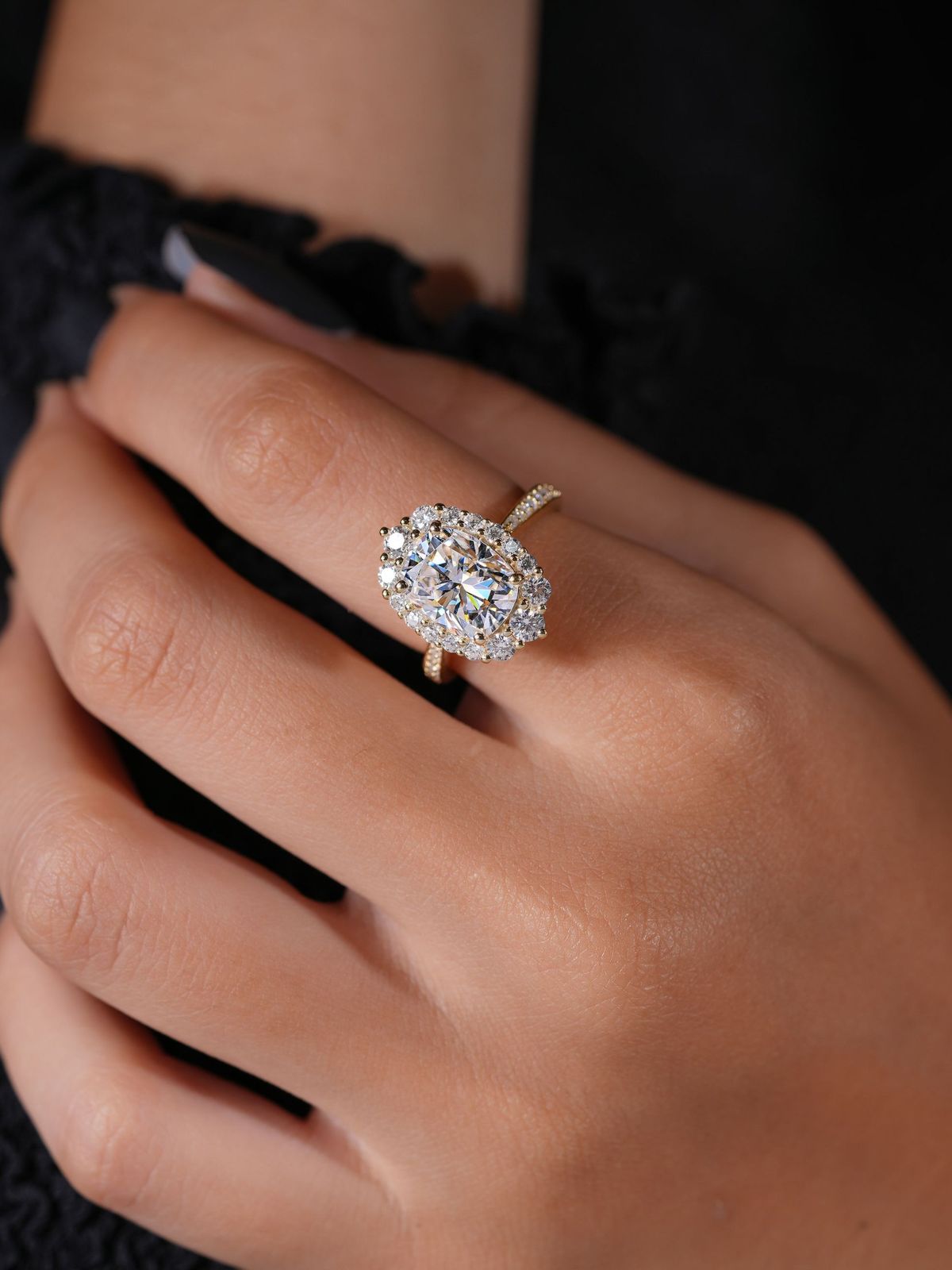
Choose a shape and carat weight to see how it sits on the hand, and how sizes compare side by side.
Sizes are approximate face-up measurements for well-cut diamonds and are drawn to scale with the finger, not to your screen. Every diamond's proportions differ, so we are always happy to show you stones in person.
Four characteristics, one diamond
Beauty you can measure
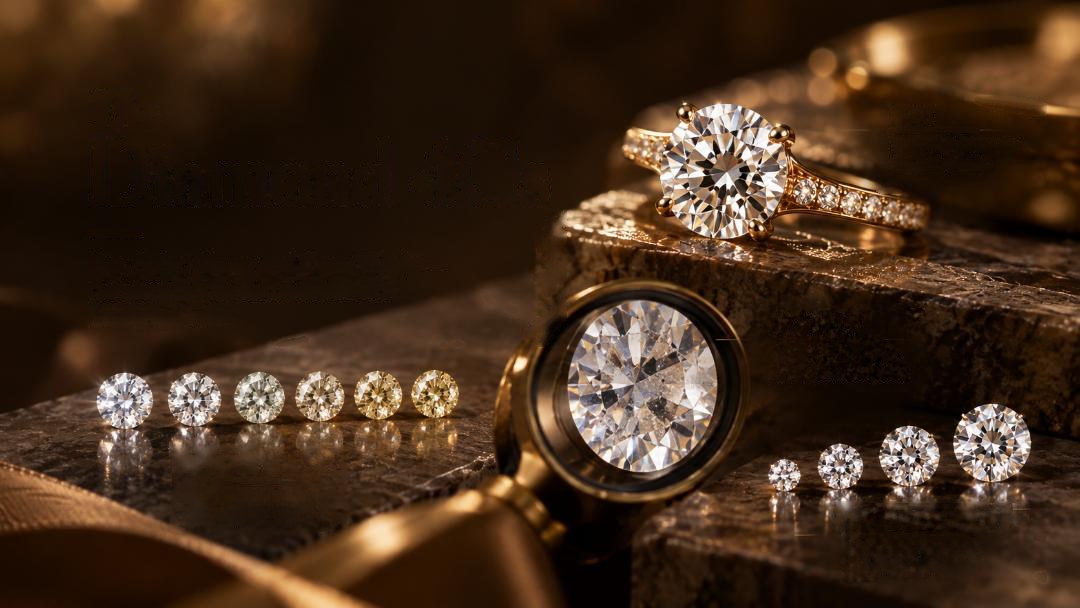
Cut, color, clarity and carat weight: the essentials behind a diamond’s beauty and value.
Every diamond is graded on four characteristics, known as the 4Cs. Together they decide how a diamond looks and how it is valued. No single C matters most: the right balance depends on your shape, setting and budget.
Cut describes how well a diamond’s facets are proportioned, angled and polished, which decides how brightly it returns light. For round brilliants, cut is graded from Excellent to Poor. Because cut affects beauty more than any other C, it is the one we recommend prioritizing.
| Grade | Description | What you will notice |
|---|---|---|
| D–F | Colorless | Icy white, the rarest grades |
| G–J | Near colorless | Looks white face-up, especially once set; excellent value |
| K–M | Faint | A soft, warm tint that is lovely in yellow or rose gold |
| N–Z | Very light to light | Visible warmth |
Yellow and rose gold flatter warmer grades; platinum and white gold show the whitest stones best.
Small crystals at 10×, invisible to the eye. Great value.
Scroll, or move across the stones, to look through the loupe.
| Grade | Meaning |
|---|---|
| FL / IF | Flawless or internally flawless: no inclusions visible at 10× magnification |
| VVS1–VVS2 | Very, very slightly included: extremely difficult to see at 10× |
| VS1–VS2 | Very slightly included: minor inclusions, usually invisible to the eye |
| SI1–SI2 | Slightly included: noticeable at 10×, sometimes visible to the eye |
| I1–I3 | Included: often visible, and can affect brilliance |
Carat measures weight, not size: one carat is 0.2 grams, divided into 100 points, so a 0.75 ct diamond is “75 points”. Two diamonds of the same weight can look different in size depending on their shape and cut. Prices rise at popular weights such as 0.50, 1.00 and 2.00 carats, so a stone just under these marks can be beautiful value. Compare carat weights in the size tool.
Shape is the outline of a diamond seen from above, and it is the most personal choice you will make. Brilliant cuts are faceted for maximum sparkle; step cuts have long, parallel facets for a calm, mirror-like glow.
Each shape is drawn at about 1 carat, to scale with the others. Notice how much larger the marquise and oval look.
| Shape | Character | Good to know |
|---|---|---|
| Round | Classic, the most brilliant | More fire and sparkle than any other shape |
| Oval | Elegant and elongating | Looks larger than a round of the same weight |
| Emerald | Step cut, a “hall of mirrors” | Shows clarity and color clearly, so choose higher grades |
| Pear | Teardrop and romantic | Protect the point with a prong or V-tip |
| Cushion | Square with soft corners | A vintage feel with chunky sparkle |
| Princess | Square with crisp corners | Modern and bright; protect the corners |
| Radiant | Rectangular brilliant | The sparkle of a round with a squared outline |
| Marquise | Long with pointed ends | The largest face-up size per carat |
| Asscher | Square step cut | Art Deco character with a windmill pattern |
| Heart | Romantic and distinctive | Best from about 0.50 ct, where the shape reads clearly |
Natural and lab-grown diamonds are both real diamonds: crystallized carbon with the same chemical, physical and optical properties, and the same hardness of 10 on the Mohs scale. They cannot be told apart by eye; specialist equipment is needed.
1–3billion years
Formed deep within the earth and carried to the surface by ancient volcanic activity.
Weeks
Grown in a laboratory using HPHT or CVD technology, which recreate the conditions that form diamonds.
Lab-grown diamonds are always clearly identified as laboratory-grown.
The setting holds your center stone and shapes the whole look of the ring. Think about your lifestyle as well as your style: a lower, smoother setting suits busy, active hands.
| Setting | What it is | Best for |
|---|---|---|
| Solitaire | A single stone on a plain band | Timeless simplicity that lets the diamond shine |
| Halo | A circle of small diamonds around the center | Extra sparkle and a larger look |
| Hidden halo | Diamonds tucked beneath the center stone | A clean profile with a surprise from the side |
| Pavé | Small diamonds set along the band | Continuous sparkle |
| Three-stone | A center stone with two side stones | Symbolism of past, present and future |
| Bezel | A metal rim around the stone | Security and a sleek, modern look |
| Cathedral | Arches of metal lift the center stone | Height and an elegant profile |
Four prongs show more of the diamond; six prongs add security and a rounder look.
Stud weights are usually quoted as carat total weight (ctw): the combined weight of both earrings. A pair of 1.00 ctw studs is two diamonds of about 0.50 ct each.
Each pair drawn to scale with the others.
| Total weight | Each stone | Approx. size (round) |
|---|---|---|
| 0.25 ctw | 0.125 ct | 3.3 mm |
| 0.50 ctw | 0.25 ct | 4.1 mm |
| 1.00 ctw | 0.50 ct | 5.2 mm |
| 1.50 ctw | 0.75 ct | 5.9 mm |
| 2.00 ctw | 1.00 ct | 6.5 mm |
| 3.00 ctw | 1.50 ct | 7.4 mm |
Typical face-up sizes for well-cut round diamonds.
| Setting | Look | Good to know |
|---|---|---|
| Four-prong basket | Classic, lets in the most light | The most popular stud setting |
| Six-prong | A rounder outline | Extra security for larger stones |
| Martini | Three prongs in a cone shape | Sits close to the ear, ideal for larger studs |
| Bezel | A metal rim around the stone | Very secure, sleek and modern |
| Halo | Small diamonds around the center | A bigger, brighter look |
| Back | How it works | Security |
|---|---|---|
| Push back | A friction back slides onto the post | Comfortable for everyday wear |
| Screw back | Threads onto a grooved post | Very secure; ideal for valuable studs |
| Locking back | Clicks into a groove and releases with a squeeze | Secure and quick to use |
| Lever back | A hinged clasp closes against the hook | Secure for drop earrings |
| Latch back | A hinged post clicks into the hoop | The standard for hoops |
The metal you choose affects color, durability, upkeep and price. Gold is mixed with other metals for strength; the karat tells you how much pure gold it contains.
| Metal | Purity | Character | Care |
|---|---|---|---|
| 10K gold | 41.7% gold | The most durable and affordable gold, slightly paler in color | Low maintenance |
| 14K gold | 58.3% gold | The best balance of color and durability, and America’s favorite | Low maintenance |
| 18K gold | 75% gold | Richer color, softer and more luxurious | Polish occasionally |
| Platinum | Usually 95% platinum | Naturally white, dense and hypoallergenic | Develops a soft patina; can be repolished |
| Sterling silver | 92.5% silver | Bright and affordable | Tarnishes; best for occasional wear |
Every gemstone has its own color, meaning and durability. Hardness, measured on the Mohs scale from 1 to 10, tells you how well a stone resists scratches, which matters most for rings worn every day.
Mohs hardness, 1 to 10. The line marks 7.5, our guide for everyday rings.
| Month | Birthstone | Hardness | Care |
|---|---|---|---|
| January | Garnet | 6.5–7.5 | Warm, soapy water |
| February | Amethyst | 7 | Avoid long exposure to strong sunlight |
| March | Aquamarine | 7.5–8 | Durable for everyday wear |
| April | Diamond | 10 | The hardest natural material |
| May | Emerald | 7.5–8 | Often included; avoid ultrasonic cleaners |
| June | Pearl, alexandrite, moonstone | 2.5–8.5 | Pearls are soft: wipe clean and keep from perfume |
| July | Ruby | 9 | Very durable |
| August | Peridot, spinel | 6.5–8 | Protect peridot from hard knocks |
| September | Sapphire | 9 | Very durable, in many colors |
| October | Opal, tourmaline | 5.5–7.5 | Opals are delicate; avoid heat and ultrasonic cleaners |
| November | Topaz, citrine | 7–8 | Topaz can chip with a hard knock |
| December | Tanzanite, zircon, turquoise | 5–7.5 | Gentle cleaning only |
Based on the modern birthstone list.
1Hold a bank card flat against the screen with its short edge along the line. Drag the slider until the line is exactly as long as the card.
2Lay a ring that fits you on the circle. Drag the slider until the circle sits exactly inside the ring.
Wrap a strip of paper around the base of your finger, mark where it overlaps, then measure the strip.
A helpful guide. For the most accurate fit, visit us for a professional sizing.
Inside diameters, drawn to scale with each other.
| US size | Inside diameter | Circumference |
|---|---|---|
| 4 | 14.9 mm | 46.8 mm |
| 5 | 15.7 mm | 49.3 mm |
| 6 | 16.5 mm | 51.9 mm |
| 7 | 17.3 mm | 54.4 mm |
| 8 | 18.1 mm | 57.0 mm |
| 9 | 19.0 mm | 59.5 mm |
| 10 | 19.8 mm | 62.1 mm |
Tips for an accurate fit
Necklace lengths
Approximate drop on an average neckline.
| Necklace length | Where it sits |
|---|---|
| 16 in | At the base of the neck |
| 18 in | At the collarbone, the most popular length |
| 20 in | Just below the collarbone |
| 24 in | At or above the bust |
Bracelet sizes
| Your wrist | Close fit | Relaxed fit |
|---|---|---|
| 5.5 in | 6 in | 6.5 in |
| 6 in | 6.5 in | 7 in |
| 6.5 in | 7 in | 7.5 in |
| 7 in | 7.5 in | 8 in |
| 7.5 in | 8 in | 8.5 in |
Measure your wrist and add about ½ inch for a close fit, or 1 inch for a relaxed one.
Personal guidance
Tell us what you are looking for, your style and your budget, and we will help you compare stones, settings and metals in person.